




Remote, unmanned sites
Pump stations, substations and valve sites are far apart and rarely visited, so every device must recover by itself after power or link loss.

Power substations, water and wastewater plants, district cooling, pipelines and fuel depots run 24/7. Their networks carry SCADA, protection and metering data, CCTV and voice, often in remote cabinets exposed to heat, dust and electrical noise. A network failure here is an operational and safety event, not just an IT problem.
Navijin GEIN industrial switches with DIN-rail mounting, metal housings and redundant power inputs connect PLCs, RTUs, cameras and sensors in control cabinets. Single-mode SFP modules link sites over kilometres of fiber, immune to electrical interference, while Navijin DRP power supplies keep the cabinet running from 48V DC.
Layer 3 switches separate control (OT), security, business and management networks into zones, following IEC 62443 principles. Managed switches support VLANs, port security, 802.1X, SSH/HTTPS and SNMPv3, and industrial LTE routers provide backup links for remote stations.
Read our critical infrastructure security checklist or request a design review.
Critical infrastructure & utilities
Utilities run SCADA, protection, metering and perimeter security across remote, harsh sites. Navijin builds hardened, segmented networks with redundant fibre rings, industrial PoE and wide-temperature power so operations keep running when conditions are worst.
The challenge
Pump stations, substations and valve sites are far apart and rarely visited, so every device must recover by itself after power or link loss.
Heat, dust, vibration and electrical noise in field cabinets destroy commercial office equipment within months.
SCADA and control traffic must be separated from CCTV, corporate IT and contractor access to limit the impact of any intrusion.
Fences, gates and equipment yards need reliable video coverage day and night, recorded centrally for investigations and audits.
Solution architecture
Industrial unmanaged and L2+ DIN-rail PoE switches connect RTUs, IP cameras and sensors inside control cabinets, powered by industrial 48 V DC supplies.
Single-mode SFP optics link sites over kilometres of fibre. Ring designs keep traffic flowing if a cable is cut.
Layer 3 PoE and managed switches route between OT, security and corporate VLANs with ACLs and QoS that protect control traffic.
IP67 bullet cameras with long-range IR watch perimeters. Recording runs on a central NVR in the control room.
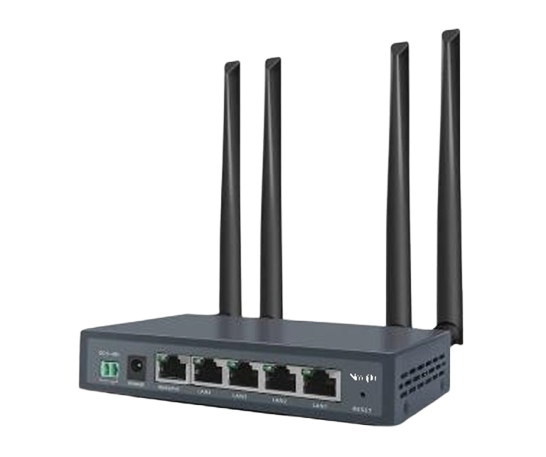
Industrial 4G LTE routers give unmanned sites an alternative path for alarms and remote access when fibre is not available.
Business outcomes
Redundant links and self-recovering hardware cut truck rolls and unplanned outages.
Segmentation between OT, CCTV and IT contains incidents and simplifies compliance audits.
Industrial-grade hardware outlasts office equipment in field cabinets and reduces replacements.
Switching, optics, power, cameras and recording from one brand with one warranty and RMA path.
How we deliver
Our engineers review floor plans, cable routes, user density, camera counts and power, then agree on measurable targets for coverage, bandwidth and uptime.
You receive a documented design: topology, VLAN and IP plan, PoE power budget, Wi-Fi channel plan and a bill of materials using Navijin part numbers.
Switches, gateways and access points are pre-configured and labelled before shipping, so installation on site is fast and repeatable.
Certified partners install, test and document every link. Wi-Fi is validated with a post-installation survey and camera views are signed off with you.
As-built documentation, admin training, firmware guidance, warranty and RMA handled through Navijin and our authorised partners.
Recommended products
Every model below links to its full specifications and datasheet.
8-port RJ45 + 2-port SFP Industrial Gigabit Unmanaged PoE Switch
View specifications →L3 PoE Managed Switch10G Uplink 26 Port Gigabit L3 Managed Ethernet PoE Switch
View specifications →L3 Managed Switch4x 10G SFP+ and 24x 1G Ethernet L3 Managed Switch
View specifications →SFP Transceiver1.25 Gbps 20KM Simplex LC SFP Module
View specifications →Bullet Camera5MP 4mm IP67 30M-IR Metal+Plastic IP Bullet Camera
View specifications →Dedicated Camera2MP Thermal & Optical Bi-spectrum Camera
View specifications →Intelligent Video Recorder128-ch Full Real Time 4U 24HDDs Smart NVR
View specifications →Wireless Router11N 300Mbps 4G LTE
View specifications →DIN-rail Power Supplies240W 48V DC Single Output Industrial DIN-rail Power Supply
View specifications →FAQ
Yes. Use the industrial DIN-rail series (GEIN and GE22xx) with an industrial DRP power supply. Check each datasheet for its temperature and ingress rating and size cabinet ventilation for the hottest day of the year.
Put SCADA/RTU, CCTV, management and corporate traffic in separate VLANs. Route between them only at a Layer 3 switch or firewall, with ACLs that allow just the required protocols.
In a ring design built on switches that support ring protection, traffic reroutes the other way around the ring automatically. For single-homed sites, a 4G LTE router can act as a backup path.
Yes. Navijin SFP transceivers and DIN-rail 48 V power supplies are designed and tested alongside our switches, so one partner can deliver the full cabinet.
Share your floor plans or site layout. We return a design, bill of materials and budgetary quotation, usually within a few working days.